Law Firm Banking
Hudson handles the complexity so your bank can service legal clients at scale without taking on the operational risk.
Win the trust account, win the firm
Larger or longer-term client funds for real estate closings, retainers, estate proceeds. Interest goes to the client.
Small or short-term client funds, pooled with three-way reconciliation. Interest remitted to the state bar foundation.
Client Trust Accounts
Real estate closings, estate proceeds, retainers, and special-purpose escrows each requiring segregated fund controls

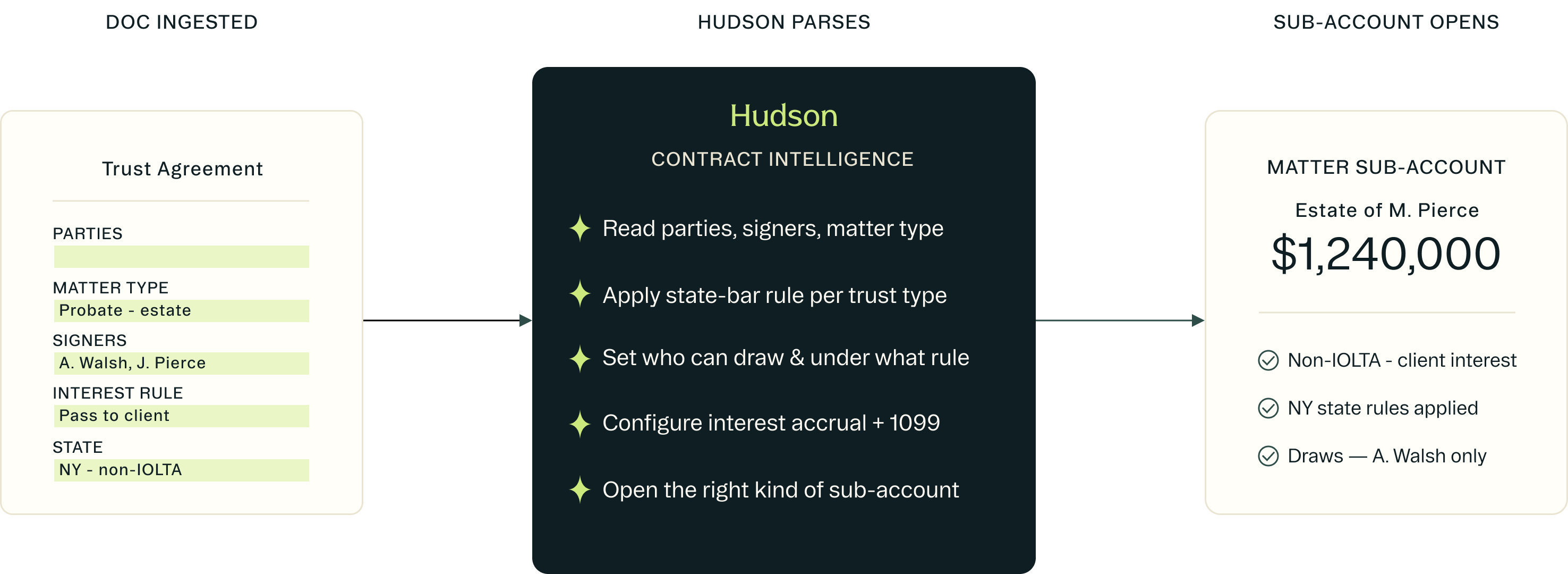
One routable sub-account per trust matter. Spun up on engagement letter, closed on matter close.
Real estate, estate, retainer, special escrow each automatically follow the right state-bar rules.
Non-IOLTA trusts pay interest to the client. Hudson accrues, allocates, and 1099s at year-end.
Retainer draws happen only when the firm bills against them. Cross-matter or unearned draws are flagged.
IOLTA/IOTA/IOLA Accounts
Single pooled trust account holding small or short-term client funds. Per-matter ledgers must reconcile to the bank statement and to the firm’s records every cycle, a three-way match. Hudson reconciles continuously, not monthly.
Client matters → pooled IOLTA → reconciled live
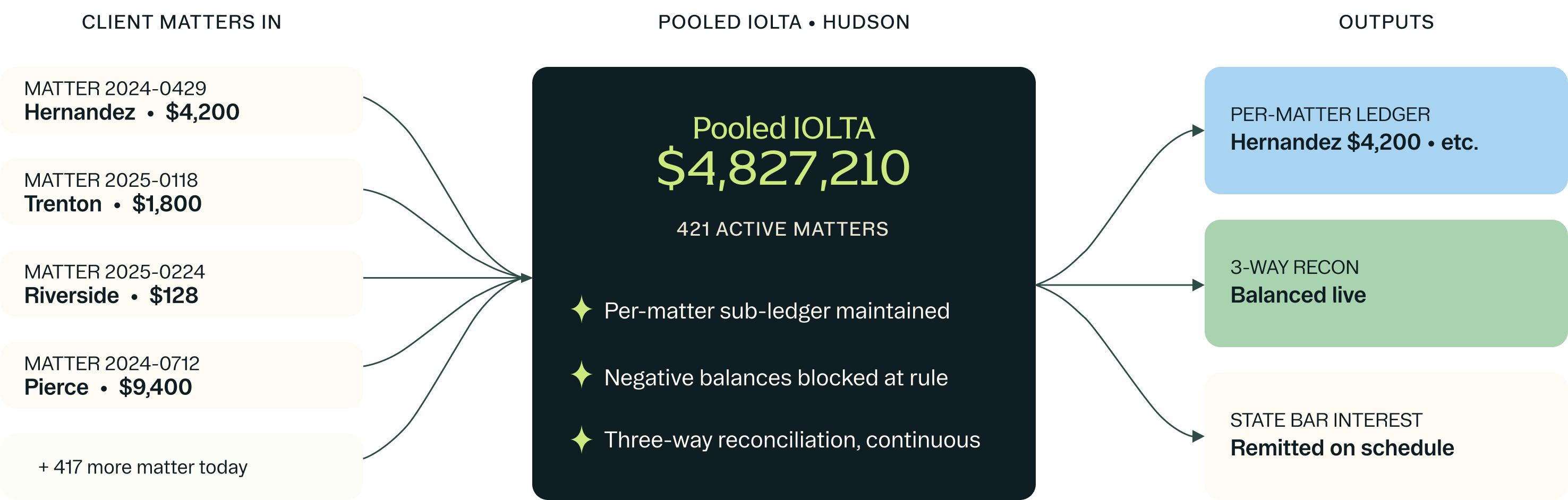
Firm ledger = bank statement = Σ matter balances.
Every dollar tracked by client and matter ID.
Interest accrues continuously and remits to the state IOLTA foundation on the bar’s schedule.
State-bar audit becomes an export. Per-matter records produced on demand.
Specialty deposit verticals
Frequently asked questions
Client trust accounts are segregated per-matter sub-accounts where interest is paid to the client; IOLTA/IOTA/IOLA accounts are pooled accounts holding smaller or short-term client funds where interest is remitted to the state bar foundation instead.
Hudson opens one routable sub-account per trust matter automatically when an engagement letter is signed, and closes it automatically when the matter closes.
Hudson reconciles continuously rather than monthly, matching the firm ledger, bank statement, and the sum of per-matter balances (the three-way match) in real time.
Yes. Real estate, estate, retainer, and special-escrow trust types each automatically follow the applicable state-bar rules configured for that trust category.
Retainer draws are only released once the firm bills against them, and any cross-matter or unearned draw attempts are automatically flagged rather than processed.
Interest accrues continuously on pooled IOLTA funds and remits to the state IOLTA foundation on the bar's required schedule, without manual calculation.
Yes. Hudson maintains audit-ready, per-matter records so a state-bar audit becomes an export rather than a manual document-assembly project.
Ready to grow deposits?
Check out how Hudson solves for the money movement and ledgering complexity that lives with Property Managers.