Riches in the niches. The biggest deposit balances in banking are not the depositors' own money.
Look at the top of any deposit-rich industry list, and you will find the same names. Municipalities, law firms, title and settlement offices, payroll processors. SouthState ranks among the top 20 every year, and at year-end 2024, the two largest were municipal and law firm fiduciary accounts, at $4.4 million per bank, roughly double everything below them. Now notice what they have in common: none of them are holding their own money.
A law firm's trust account belongs to the firm's clients. A title company's closing funds belong to the buyer and the seller. A payroll provider's float belongs to somebody's employees. The money is parked mid-journey, and a contract, a statute, or a fiduciary duty says exactly where it sits and exactly how it moves.
Bankers call these specialty deposits. You do not necessarily win them with rate. You win them by understanding their industry and providing banking products that fit exactly how their businesses operate.
Which means there are really two kinds of deposits. Money you rent, and money you are trusted with. Compare a 12-month CD to an IOLTA account, and you will see the difference.
The CD came to you because you posted the highest rate in town that week; it pays 4% and up if you are winning promotions against a 1.65% national average, and it leaves at maturity for 10 basis points down the street. The IOLTA is the firm's clients' money. It came to you because you run the trust accounting the firm's law license depends on. The firm is not shopping yield; the interest goes to the state bar's legal aid program, and it leaves when the firm stops practicing law.
The pattern holds across the whole list. Here are the 15 biggest deposit-rich industries in the US, by average balance per bank.
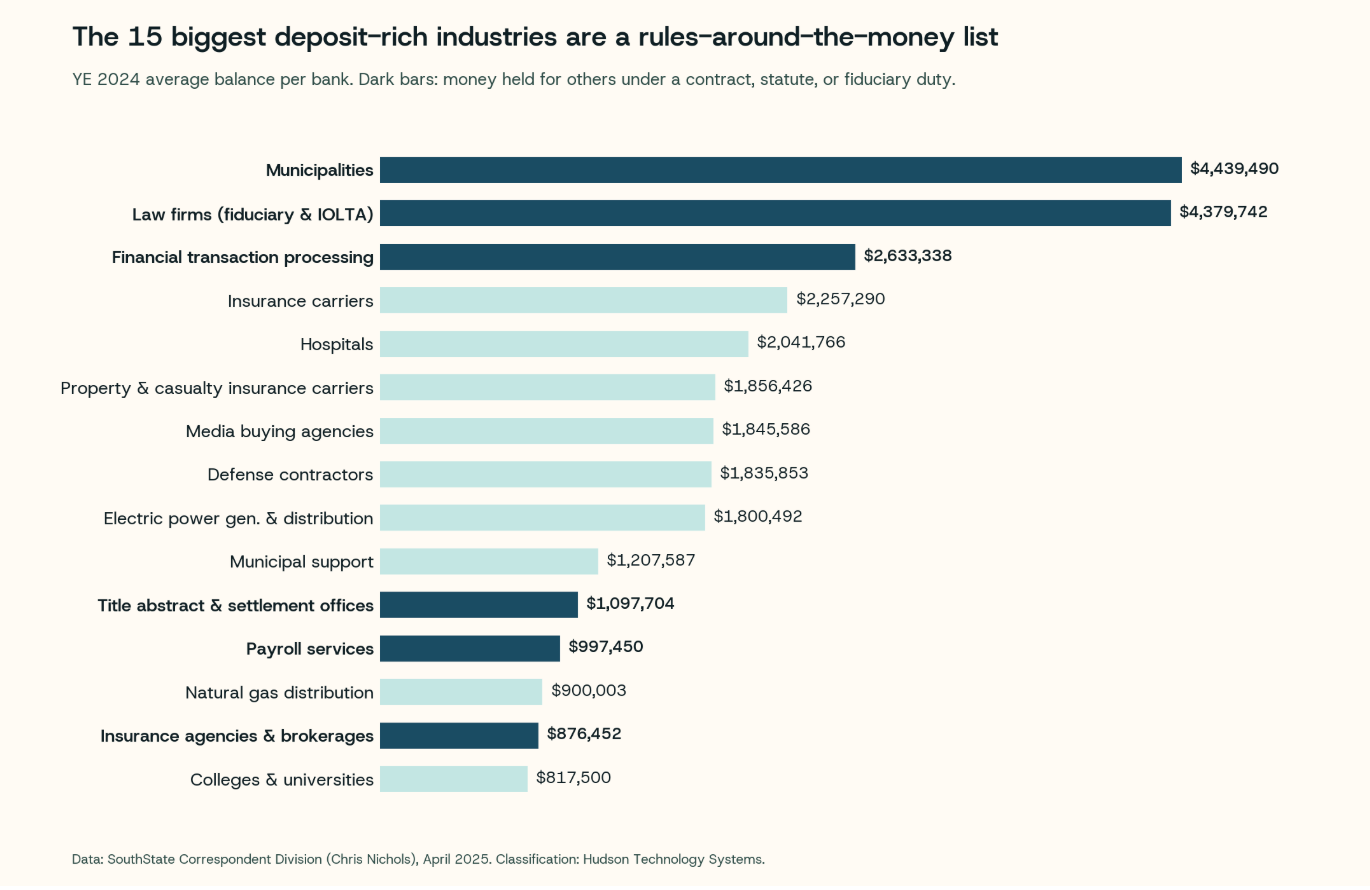
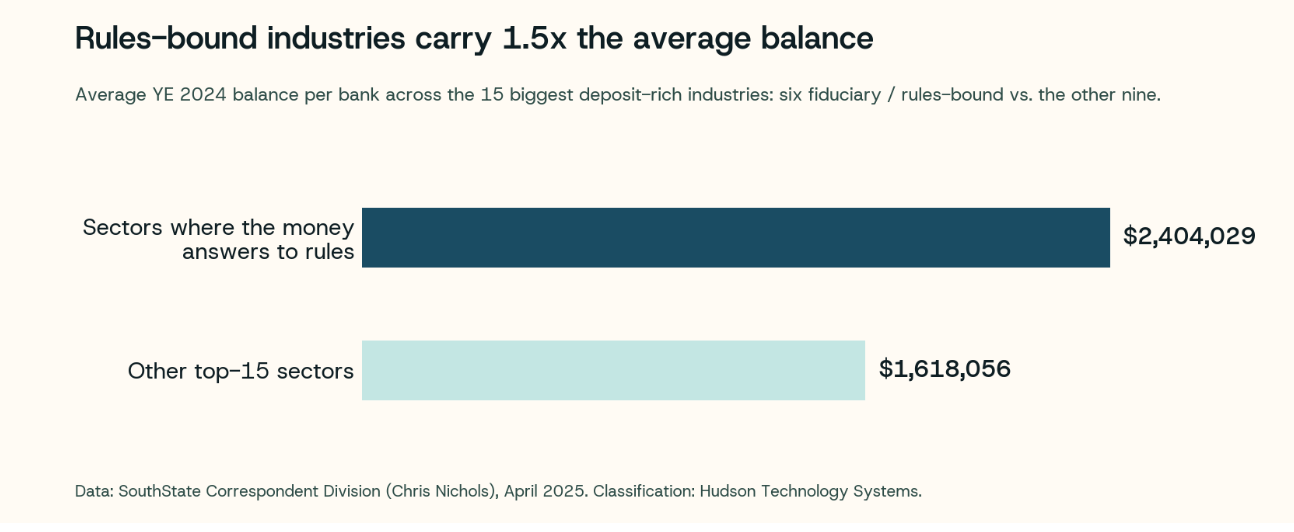
The dark bars are money held for others under some rule. Six of the fifteen industries, and nearly half the balances on the list, sit behind that kind of rule. Those six carry 1.5 times the average balance of the other nine.
Now compare the costs. The CD is expensive. You pay 4% to win money the market average pays 1.65% for, and it leaves in a year. SouthState says it: many CD-only customers lose the bank money. The IOLTA is the opposite. It costs almost nothing in rate and everything in the back office. If you want to specialize, you’ll need talent that knows the market and brings their portfolio. But to convince them to do that, you also need to build a strong back-end treasury infrastructure that can keep up with the complexity of operating law firms, segregating funds, robust reporting and reconciliation, and access to every payment rail.
Here is the good news: only one of those two problems is actually yours. The talent, the relationships, the choice of which niche to enter- that is all part of doing banking. The infrastructure half is different. It used to mean a multi-year build or five new hires. It doesn't anymore. Treasury technology has reached the point where the ledgers, the reconciliation, the reporting, and the rails can be configured to a niche's rules instead of built for it, one vertical this year, another the next, without adding admin work. Which shrinks the whole decision down to the part that was always the real question: where do you want to compete, and how are you going to win?
To be fair, rules-bound does not mean free. SouthState flags municipal money for exactly this: it wants collateral and indexed rates. But for most of the list, the bank that does the work keeps the balance, and rate never enters the conversation.
And here is what most banks miss: the rules are already written down. The trust accounting requirements are set out in the bar rules. The escrow conditions exist in the signed agreements. Most banks already have a small team looking over these agreements and documents and building out onboarding and payment workflows.
That is the work we do. Hudson turns the rules around the money into software. Learn more here.
If you want to specialize as a deposit strategy, let's talk. Happy to show you which niches your bank is already halfway into.
Sources: SouthState Correspondent Division (Chris Nichols), The Top 20 Deposit-Rich Industries for 2025, April 2025; FDIC National Rates and Rate Caps, June 2026; Hudson production platform data, 2026.
Learn how Hudson’s system can
transform your operation
Book a discovery call to learn how escrow products create new revenue streams and elevate consumer trust.