What would your balance sheet look like with specialty deposits?

Use our interactive calculator to model the impact of replacing FHLB advances with low-cost specialty deposits.

A smarter funding source
hiding in plain sight
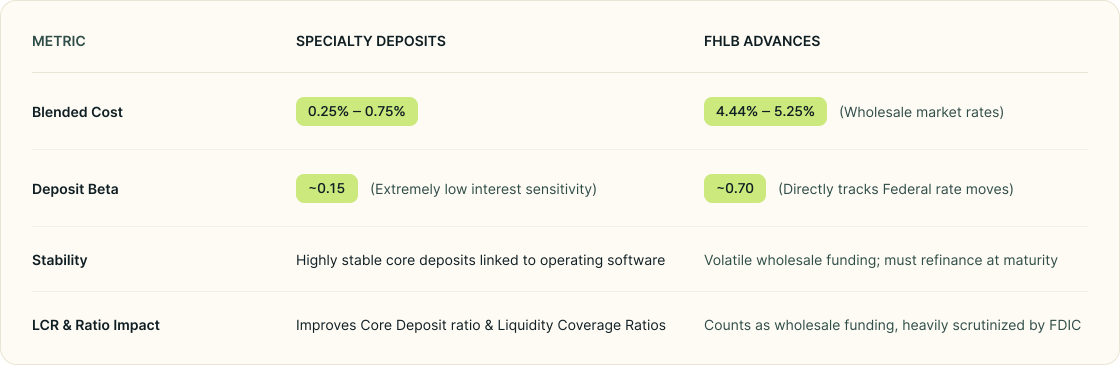
Escrow, 1031, HOA, municipal, law-firm, and settlement balances pay little to nothing and rarely leave. By converting these operational flows, they replace wholesale-priced FHLB advances, dropping the rate gap straight to pre-tax profit.
$5B+
Processed last year
Reliable transaction volumes generated by core business customers running on our automated rails.
50+
Banking partners
Banks of all sizes utilizing our white-label infrastructure to secure low-beta relationship balances.
4.0%+
Average rate savings
The direct interest margin saved by replacing wholesale market rates with operational relationship capital.
Specialty deposits vs. FHLB advances
Model your savings
Step 1 of 4

Where you stand today

Dollar amounts in thousands ($000s). "1,800,000" means $1.8 billion.

$
%
$
%
$
%
$
%
4.61% Net interest margin today
2.27% Blended cost of funds
$8.5M FHLB interest expense per year
$96.4M Net interest income per year
Step 2 of 4 · Lever one

Refinance FHLB advances with specialty deposits

Escrow, 1031, HOA, municipal, law-firm, and settlement balances pay little to nothing and rarely leave. Swap wholesale-priced FHLB advances for these deposits and the rate gap drops straight to pre-tax profit.

%
$96.0M
Funding this trancheRateAnnual cost
Before: FHLB advances 4.44% $4,262,400
After: specialty deposits 0.50% $480,000
Lever one savings N/A $3,782,400
Step 3 of 4 · Lever two

What a Fed rate move does to that gap

FHLB advances reprice almost immediately when the Fed moves. Specialty deposits barely move at all. That gap is where the protection lives, on top of what lever one already saves.

bps
Funding typeBetaRate todayRate at shock
FHLB advances 0.70 4.44% 5.14%
Specialty deposits 0.15 0.50% 0.65%
Rate gap N/A 3.94 pts 4.49 pts

Extra protection from lever two

$528K

a year stays protected on top of lever one, because FHLB advances reprice faster than specialty deposits when the Fed moves.

Step 4 of 4

The bottom line

Move $96.0M of FHLB advances priced at 4.44% into specialty deposits priced at 0.50%, and the same assets get funded for $3.8M less every year.

$3.8M saved per year at today's rates
Cost of this tranche today $4.3M
Cost as specialty deposits $480K
+18 bps added to net interest margin, across every dollar of earning assets
2.27%2.07% blended cost of funds, before and after
$4.3M saved per year if rates move +100 bps, levers one and two together

Whole balance sheet, before and after

MetricBeforeAfter
FHLB advances $192.0M $96.0M
Deposits $1.65B $1.75B
Blended cost of funds 2.27% 2.07%
Net interest margin 4.61% 4.79%
Net interest income per year $96.4M $100.2M

Lower interest expense

$3.8M a year comes straight out of interest expense by paying specialty deposit rates instead of FHLB rates on this tranche.

Wider margin

Every dollar of earning assets picks up 18 bps, not just the refinanced tranche.

Steadier through rate moves

An extra $528K a year stays protected if the Fed moves, because specialty deposits barely reprice.

Less wholesale reliance

$96.0M moves off a FHLB line and onto deposits your bank owns the relationship on.

Next steps

This is a starting point built on the ACME Bank example. Every bank's structure is different. Here's what we'd dig into together to build this on your own balance sheet.

Your FHLB prepayment terms

We'll pull your actual advance schedule and see what it costs to pay down early, tranche by tranche.

What it costs to win these deposits

We'll walk through platform, onboarding, and compliance costs so the savings you see are net, not gross.

Your bank's own repricing history

We'll validate FHLB and deposit betas against how your book has actually repriced, not a generic assumption.

How sticky these deposits really are

We'll size your mix of escrow, 1031, and other programs and look at actual balance behavior, not an assumed beta.

Your liquidity and concentration profile

We'll factor in uninsured concentration and how it fits your risk appetite, not just the funding cost side.

Collateral and pledging requirements

We'll price in what public funds or other pledged deposits actually cost you to carry.

How the calculator works
STEP 1
Enter current position
Input your existing balance sheet values: total loan portfolios, blended yields, cash reserves, and current FHLB wholesale advances.
STEP 2
Model the levers
Adjust your target specialty deposit rates, choose how much wholesale funding to refinance, and stress-test the model against potential Fed rate shifts.
STEP 3
See the bottom line
Instantly view annual savings, overall NIM improvement, and evaluate your asset-liability matching (ALM) rate-shock protection.
Every number is yours to change. This isn't a black box; it's a transparent financial modeling tool built directly for treasury and bank finance teams.

Frequently asked questions

How do sub-accounts map to a higher-level general ledger?

Each sub-account category maps to a GL code you define, with sub-account-level suffixes, so activity rolls up to your core exactly the way your reporting expects. Mapping is configured during onboarding.

How does Hudson connect to our core?

Two options. Hudson is assigned a dedicated routing number, or Hudson manages a defined range of account numbers synced from your core. Either way, sub-accounts stay reconciled to the on-core master account.

Is the platform offered under our brand?

The platform is offered as a white-label solution. You'll launch using your brand identity.

How does this work with our current virtual account vendor?

Two options. We can work in parallel with your incumbent vendor, or replace them. No matter the approach, we chart a phased path to migrate you onto routable sub-accounts, typically within 90-120 days.

Is transaction size or volume a consideration?

Our clients process millions of on-platform transactions totaling billions in annual volume. We built our technology for scale and look forward to working with you to launch modern virtual accounting and treasury management solutions.

Ready for a custom analysis?

Our team will apply this model to your actual balance sheet, identify which specialty deposit
verticals fit your market, and build a phased implementation roadmap.